· By Wataru Ito · Coding · 30 min read
I, Developer
What earlier waves of automation can tell me, and what they can't, about AI and my future as a developer.

I use AI every day. In a short period of time, it has almost replaced Googling for me. Like, I can barely remember the last time I relied solely on my Googling skills to solve problems, ranging from web development to finding somewhere to eat dinner in a new place I was visiting. And before that, of course, there was a time when Google was new. And there was, you might not believe it, a time when there was no “internet.”
These days, I see, or try not to see, the elephant in the room. A big elephant. Is this gonna kill my job?
There are certainly historical precedents where technological change disrupted countless lives and jobs. Sometimes with deadly consequences. As a history buff, I wanted to make a note of what happened and see how we can predict (or not predict) the future.
The Rise of Spinning Technologies, the Industrial Revolution, and Social Unrest
The first example that comes to my mind is Britain’s cotton industry. People spun yarn on wheels and wove cloth on hand looms, often at home. These were separate jobs, and mechanizing them had different consequences at different times.
Hargreaves developed the spinning jenny in the mid-1760s, Arkwright patented his spinning machine in 1769, and Crompton developed the mule around 1779. The jenny was hand-powered; Arkwright’s water frame helped bring spinning into water-powered factories. Steam power followed. Manufacturers spent decades improving the machines and reorganizing production.1
Productivity kept rising. Economic historians estimate annual yarn output, including preparation, at about 94 pounds per full-time worker for hand spinning, 187 for an early jenny, 894 in 1817, and 2,919 in 1850. These rough comparisons do not control for yarn quality or machine type, but they show how much manufacturers gained through improvements after the first inventions.2
For hand-loom weavers, cheaper machine-spun yarn initially meant more work. Robert Allen reconstructs a rise in their numbers from about 37,000 in 1780 to 240,000 in 1820. Their earnings rose during the early expansion. Then power looms became more competitive: hand-weaving wages collapsed in the 1820s, followed by falling employment in the 1830s and 1840s.3
Richard Guest’s 1823 account makes the change concrete. He described 200 power looms, attended by 100 people under twenty and 25 adult men, producing 700 pieces of cloth a week. He calculated that the same output required 875 hand looms, supporting more than 2,000 people including dependents. Far fewer workers could now produce what had supported hundreds of households. Guest was comparing production systems, counting dependents on the hand-loom side. His figures do not tell us how many individual workers lost their jobs, or how many found other work.4
Charles Babbage published a local employment comparison in 1832, drawing on an enumeration covering 65 factories in Stockport:5
| Work in the reported Stockport comparison | 1822 | 1832 |
|---|---|---|
| Hand-loom weavers | 2,800 | 800 |
| People operating power looms | 657 | 3,059 |
| People preparing the warp | 98 | 388 |
| Total people employed | 3,555 | 4,247 |
Total employment rose about 19%, while the number of hand-loom weavers fell about 71%. Babbage pointed out that the people losing the old work were not necessarily those taking the new jobs. Factory owners could employ women and teenagers on power looms; construction, engineering, and supervision called for other experience. An expanding industry could leave an established worker with fewer ways to earn a living.
Babbage also recognized that learning new work took time. A hand weaver could lose income before acquiring the skills a different employer needed. The total number of jobs, measured across a town or an industry, would tell us little about how that household managed the interval.
The story also complicates the idea of skilled men being replaced by women and children. Women and children had already done most domestic hand spinning, so mechanization threatened their livelihoods too. Men still worked the common mule in the 1830s. In 1835, factory advocate Andrew Ure welcomed the prospect that self-acting mules would let owners dispense with male spinners and retain younger workers. His account records an employer’s incentive to reduce dependence on skilled men, rather than proving their replacement was complete. He cited an owner near Stockport who expected to save £50 a week by dispensing with nearly forty male spinners. That was a proposed wage saving, not a survey of what happened to those men afterward.6
Factory employment meant accepting the factory’s hours. The 1833 Factory Inquiry reported regular twelve-hour working days in Manchester and commonly twelve, sometimes thirteen, in Leeds, excluding meals and other stoppages. Some factories operated day and night, but the report described separate shifts: commonly two groups working twelve hours each, sometimes three working eight. Around-the-clock production did not mean one person worked all those hours.7 Parliament’s 1833 Factory Act prohibited employment below nine in the mills it covered, except silk mills, and introduced schooling requirements and four inspectors. For children under thirteen, phased-in limits allowed nine hours a day and forty-eight a week, with a silk exception. Finding work could mean spending most of a childhood day attending machines.8
Workers fought back. Machine-breaking predated the Luddites: Hargreaves’s machines were attacked in 1768, according to a later biographical account. The Luddite disturbances began in Nottinghamshire in 1811 and spread to Yorkshire and Lancashire in 1812, involving different textile trades and grievances.9
A letter from Nottingham magistrate Robert Baker, dated February 6, 1812, describes the pressures. He reported that, before the disturbances, a fifth of the framework knitters in many places were unemployed. Some employers offered reduced rates, undercutting those paying more. Attacks targeted the frames of employers paying those lower rates and wider frames that made the work easier. Baker also mentioned a shortage of grain. Workers were fighting over wages and their ability to feed themselves. Baker also noted that they generally left other property alone; in one case, someone returned cloth taken during an attack. His account describes selective attacks on employers and equipment associated with their grievances.10
The government answered with severe punishment. In 1812, Parliament made the destruction of stocking and lace frames a capital offence. The Commons debate records objections that hanging offenders would do nothing to remove the distress behind the attacks.11
These records cannot give me a reliable nationwide total of jobs lost to machinery. Babbage himself complained about missing employment and wage data. But the local figures make me uneasy about assurances that AI will create more jobs in the end. I could lose my livelihood while the industry around me grows. New work elsewhere, or twenty years later, would not pay my bills in the meantime.
The Computers Replaced by… the Computers!
Another example is the fate of computers. I mean the people. Before the word became the name of a machine, a computer was someone who calculated: star positions, artillery trajectories, aircraft performance, or the tables other scientists and engineers needed. They worked with paper, mathematical tables, and mechanical calculators. In several of the laboratories that later became NASA, this became a largely female occupation.12
Langley’s first centralized computer pool began with five women in 1935. By 1946, Virginia Tucker’s department had trained about 400 women and placed them in sections across the laboratory. That is a cumulative training figure, rather than a count of 400 people sitting in one room. Their work included reading wind-tunnel measurements, calculating results, and plotting data for engineers. Some developed numerical methods, wrote handbooks, and coauthored research papers. The work required more than patient arithmetic.12
The machines could nevertheless perform the arithmetic at a different speed. In a 1961 account, the Army’s Martin Weik compared the time needed to calculate a single sixty-second projectile trajectory:13
| Method | Calculation time |
|---|---|
| Skilled person using a desk calculator | About 20 hours |
| Mechanical differential analyzer | About 15 minutes |
| ENIAC | About 30 seconds |
On that comparison, ENIAC ran the calculation about 2,400 times faster than the person with a desk calculator. That measures a particular computation, not the time needed to prepare an entire project. Weik also described weeks of setup and checking when programmers introduced new problems. Someone still had to translate the mathematics into instructions, connect the machine’s units, and establish whether the answer was right.13
Some of those people came from the occupation the machine was taking over. Six women became ENIAC’s original programmers. Kathleen McNulty, one of the six, recalled that the Moore School’s human-computing operation had at one point employed about 100 women on two shifts. The incoming shift continued the unfinished trajectory calculations of the previous one. She and her colleagues already understood the work ENIAC needed to perform.14
W. Barkley Fritz’s history records additional women joining ENIAC programming later. The six original programmers were the beginning of a group, and their careers show one route from hand calculation into machine programming. The hundred-person recollection gives a sense of the operation’s scale, but does not trace everyone’s later employment. Manufacturers and laboratories needed people to prepare and control calculations as machines reduced the need to execute each arithmetic step by hand.14
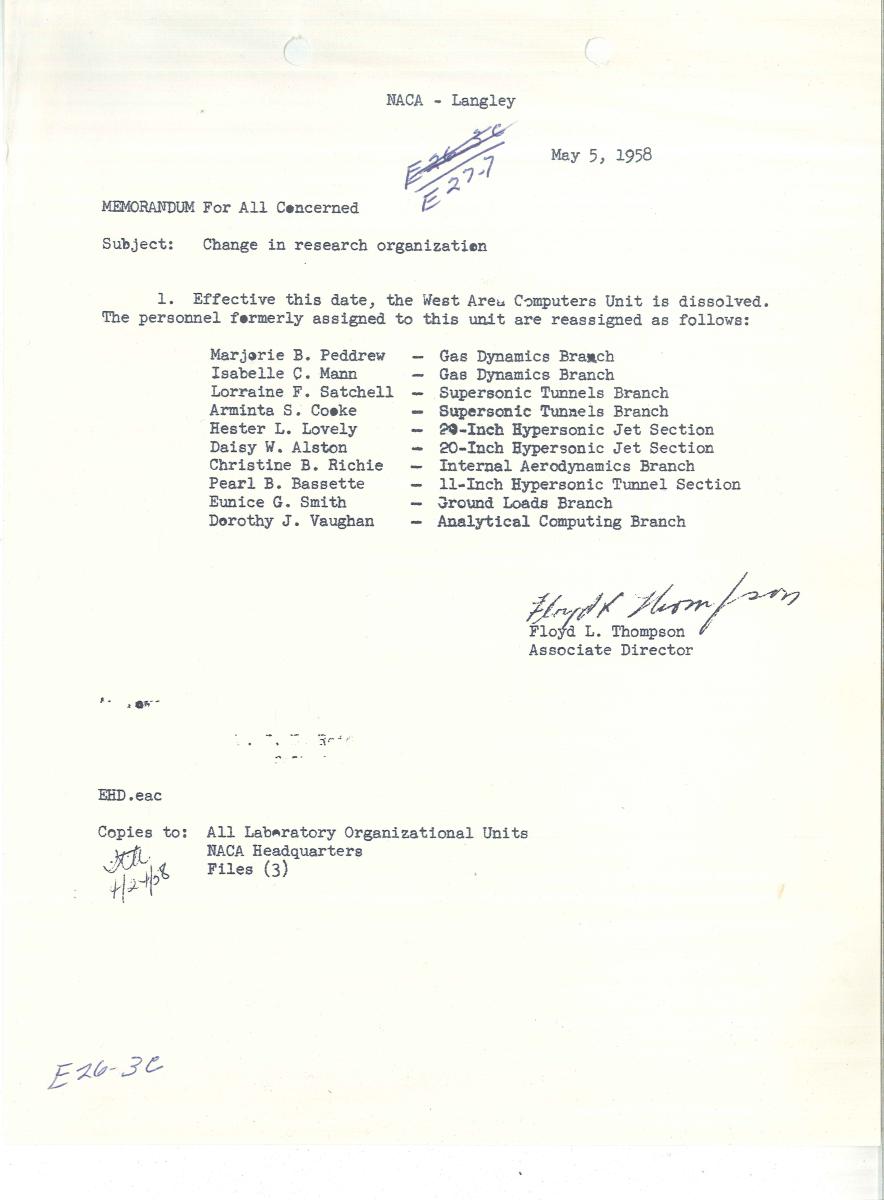
Langley’s records show another kind of transition. A memorandum dated May 5, 1958, dissolved the segregated West Area Computers Unit and listed new assignments for all ten women named in it. Most went to research branches; Dorothy Vaughan went to the Analytical Computing Branch. The unit disappeared, while the memo explicitly reassigned its staff.15
Vaughan had led West Computing since 1949. Black women in the unit had worked under segregation, with separate dining and bathroom facilities. Vaughan later became an expert FORTRAN programmer and remained at NASA until 1971. Her technical career continued, but she sought and never received another management position at Langley. Keeping employment and keeping professional standing were different outcomes.16
At the Lewis laboratory, former computer Sandra Jansen recalled that electronic machines reduced the need for human computers, but she remembered no one being forced out for that reason. Some left after marriage or pregnancy; some returned to school and became programmers. Jansen herself moved into programming and supervision. That is one participant’s account of one laboratory, not a nationwide employment survey. It does, however, make a blanket claim that most human computers were fired difficult to defend.17
Japan had its own keisanshu, or human calculators. At Fuji Photo Film, women worked in pairs, checking calculations made with six-digit logarithm tables to trace light through photographic lenses. Developer Bunji Okazaki recalled several dozen women doing this work near the end of the war. Their number fell to a few after the war ended, years before his electronic computer was completed. That decline cannot simply be counted as computer-induced unemployment.18
Okazaki’s FUJIC, completed in 1956, automated those lens calculations. He reported an average speed around 2,000 times that of calculation using logarithm tables. The figure describes the calculation method, rather than a documented replacement of 2,000 employees. The Information Processing Society of Japan preserves the same performance estimate in its account of the machine.19
Weather prediction gives another measure of the change. Japan’s Meteorological Agency began numerical forecasting with an IBM 704 in 1959. In a report published that year, Kikuro Miyakoda estimated that the repeated calculations for one time step of the JMS001 forecast program would take a person using a hand-cranked calculator roughly 63 days of continuous work. An IBM 704 test took about two and a half minutes. This was one computational stage, tested in Washington, not a complete forecast produced in Japan. Miyakoda also recorded twenty days spent coding and checking the program’s 415 FORTRAN statements.20
So the occupation changed more decisively than the employment records let me count. Machines took over the repeated arithmetic; people programmed them, prepared data, checked results, and attempted calculations that had previously taken too long. Some former computers made that transition, and surviving records name them. I cannot turn those careers into proof that everyone found a new place, any more than I can claim that most were dismissed. For my own work, I find the practical question more useful: which parts will a machine take over, and what experience will let me do the work that follows?
The Rise of Desktop Publishing and the Extinction of Typesetting Artisans
In Japan’s printing trade, selecting and arranging metal type was skilled work and was in high demand in the 1960s, when the postwar economic boom quadrupled the Japanese economy. At Nakanishi Printing in Kyoto, Hidehiko Nakanishi recalled roughly 100,000 types across different characters, typefaces, and sizes. Experienced workers could pick type while looking at the manuscript rather than the shelves. Becoming fully proficient was said to take ten years. Their knowledge included where to find a character, how to fit a line, and how to assemble a page that would print correctly.21
In turn, experienced artisans were in demand and could be well paid.22 In Japan, where the appetite for the written word went back well before the modern era, demand for their skills seemed endless. Newspapers needed quick work for their gōgai, or extra editions, while magazines wanted fast turnarounds for their scoops.23 Publishers were bringing out more books, both fiction and nonfiction.24 These skilled workers held an important place in that world. Yet within a few decades, many of those jobs had gone the way of the dinosaurs.
The change began well before desktop publishing. Nobuo Morisawa applied for a Japanese phototypesetting patent in 1924; a practical machine followed in 1929. Phototypesetting used photographic images of characters instead of assembling metal type. As offset printing spread, printers adopted new ways of preparing text for the press. Operators still needed to select characters, set spacing, and produce usable output. They worked with different equipment, but the publisher still depended on specialist production work.25
Computerized phototypesetting added another stage. JAGAT’s industry history dates its arrival to 1969 and records an industry modernization plan promoting the move away from metal type in 1971. These dedicated systems preceded the personal-computer workflow. A useful Japanese DTP milestone came in 1989, when Apple’s LaserWriter NTX-J shipped with Morisawa’s Japanese PostScript fonts. Designers could increasingly combine text and images into finished pages on their own computers.26
That brought tasks previously divided among typesetters, paste-up workers, and prepress specialists into one digital workflow. But DTP did not make every printing plate disappear. Offset presses still used plates; computer-to-plate systems later recorded digital pages directly onto them, removing the intervening film. Digital printing could dispense with those plates. Page composition, platemaking, and printing were related jobs, and different technologies changed each one.27
One company’s record shows how uneven the transition could be. Nakanishi Printing introduced electronic typesetting in 1986 and ended letterpress production in 1992. In his account of the change, Nakanishi divided the former letterpress craftspeople into three groups: one-third became computerized-typesetting operators, one-third moved to other assignments, and one-third left the company. He also described retaining traditional expertise for difficult scholarly work, including mathematical formulas and historical texts. These are his recollections of one firm, rather than a national retraining or unemployment rate.28
The wider industry also contracted. An industrial census series reproduced by the Japan Federation of Printing Industries records employment in printing and related industries falling from 473,409 in 1990 to 330,772 in 2010, about 30%. That category includes printing, platemaking, binding, and other related work. It cannot tell us how many typesetters DTP displaced. JAGAT’s account also describes the collapse of Japan’s bubble economy, declining shipment values, and competition from other media alongside the technical changes.29
So this was a succession of changes to equipment, tasks, and who controlled the page. Some skilled workers carried their experience into new systems; others changed jobs or left. I would be careful about calling that a painless transition simply because it took decades. Knowing how to make a good page could still matter, while the equipment and production arrangements that had made someone indispensable disappeared around them.
Here Come the Cars. Time to Rest, Horses!
Horses offer a harsher example of technological displacement. Cars and trucks took over road transport, while tractors replaced much of their work on farms. This was a broader change in mechanical power than the arrival of the passenger car alone.30
In the United States, the number of horses and mules on farms fell from about 26.5 million in 1915 to 3.1 million in 1960, a decline of roughly 88%. Those figures include mules and cover farms; they are not a count of all American horses or animals displaced specifically by cars.31
A horse could not retrain as a mechanic or learn to program the machines replacing it. That makes this a different story from the human computers and typesetters who carried some of their experience into new work. It does not tell me that humans will meet the same fate. But it leaves me with an uncomfortable question: what if AI reduces demand for my skills faster than I can find another use for them?
Japanese Media After YouTube and Social Media
This example feels closer to home. I’m from Japan and still follow Japanese media closely, so I have a personal interest in what has happened to television, newspapers, magazines, and publishing. I also feel I know this change in more detail than the earlier examples, though much of that familiarity comes from being a viewer and reader.
In 2025, more than half of all advertising spending, about 4 trillion Japanese yen, went to internet advertising. Television advertising, including terrestrial and satellite broadcasting, was about 1.76 trillion Japanese yen. It fell only 0.3% that year, so the figures show a much larger online market alongside a still substantial television business.32
Print has suffered a sharper contraction. Newspaper circulation more than halved, from about 53.7 million in 2000 to 24.9 million in 2025. In publishing, estimated sales of printed books and magazines fell 4.1% in 2025, while electronic publishing grew 2.7%, largely supported by digital manga. Even within print, the outcomes differed: magazine sales fell 10%, while book sales were roughly flat. Calling all of this the death of publishing would miss where readers and spending have moved.3334
Employment changes are harder to count. Fuji Television’s 2022 voluntary retirement scheme is one documented example, although the company described its purpose as supporting second careers and changing its age structure. I would not read that as a headcount of people replaced by YouTubers. Falling sales alone cannot tell me who was dismissed, who retired, and who found work elsewhere.35
In my eyes, the quality of TV shows has declined. Primarily due to a lack of funding, broadcasters often resort to “variety” shows, where TV personalities basically talk about anything. There used to be more documentaries, more detailed news shows, and such. These haven’t disappeared, but they have become scarcer.
What interests me is how much the new and old media overlap. YouTubers such as HIKAKIN seem to me to have taken over some of television’s role as everyday entertainment. Yet HIKAKIN also appears on television: Fuji featured him as a judge on All-Star Choir Battle in 2024, while promoting the show’s rehearsals and backstage footage on TikTok. The platforms compete for attention, but the same people and programmes move between them.36
My impression, from following Japanese media, is that this looks less like a simple story of unemployment and more like a division of roles. YouTube and social media have taken over parts of entertainment, commentary, and the discovery of new things to read or watch. The established entertainment industry and traditional news have not died. They still have audiences, people, and work that the newer platforms draw on. That is a personal reading of what I see, not a claim that everyone has found a new job. The part I find interesting is that the old media can lose some of their former place while continuing to matter.
So What’s Next?
Anthropic is flooding us with blog posts that describe how humans are no longer writing code, how the number of their MRs is no longer manageable with traditional Git, and how reviews are now handled by AI, with human eyes seeming to be just one component in the process.
There’s this article, Big Tech’s Looming Capability Crisis, arguing that the human role will never become obsolete. But my personal feeling is the opposite. It’s just a gut feeling. (Or maybe I am secretly hoping for an AI overlord. I don’t know.)
I asked AI, in Japanese, what it thinks about this topic and the future of my job. Then I had it summarize its answer and translate it into English. It claims the answer below is a “SHORT” one. Well, its idea of short is different from mine. But anyway, here is its answer.
The AI’s Answer
The Short Answer
Yes, I think AI could eliminate a substantial number of software development jobs. And over the longer term, the profession itself may become almost unrecognizable.
That does not mean every programmer will become unemployed. Software development could expand enormously even as the number of people employed to do it declines.
The distinction matters.
Your historical examples reveal something that tends to get lost in optimistic predictions about technological progress: an industry can become more productive, more profitable, and even employ more people overall while leaving particular workers without a livelihood.
The hand-loom weavers of nineteenth-century Britain are an especially revealing example. Mechanized spinning initially increased demand for their work. Later, power looms destroyed the economic value of their skills. The industry grew, but that did not necessarily help the people it displaced.
I think we should take that possibility seriously when considering AI.
What Makes AI Different?
There is a familiar argument about technological change: machines eliminate some jobs but create new ones.
It has often been true.
Mechanization replaced agricultural labor, but people found employment in factories and services. Electronic computers replaced human calculators, but created demand for programmers, systems engineers, and other technical specialists. Desktop publishing eliminated many traditional typesetting jobs while opening opportunities for designers and computer operators.
In each case, people could move toward work that the new machines could not perform.
But AI introduces a troubling possibility: what if the machines can eventually perform the new jobs as well?
Today, programmers are encouraged to become AI supervisors. Rather than writing code themselves, they should concentrate on architecture, requirements, testing, and code review.
That is sensible advice for the near future.
But why should we assume that architecture and code review will remain exclusively human activities?
AI systems are already moving beyond code completion into planning, debugging, testing, and reviewing other AI-generated code. The same technological progress that allows AI to implement a feature could eventually allow it to decide how that feature should be designed.
Moving one level higher in the development process might postpone displacement without preventing it.
Of course, there are real obstacles. Complex software projects involve ambiguous requirements, organizational politics, security, legacy systems, and accountability. An AI that writes excellent code is not necessarily capable of managing all those constraints.
But those are reasons to question how quickly automation will happen, not proof that it cannot happen.
An Industry That No Longer Runs at Human Speed
Consider what is happening at Anthropic itself.
In October 2026, the company described how the growing volume of AI-generated development work had forced it to reconsider its source-control infrastructure. Its reported daily code merges increased from roughly 2,500 in May to more than 30,000 in September.
The company developed a new system, Scion, to handle workflows that traditional Git-based infrastructure was struggling to accommodate.
These figures do not demonstrate a twelvefold increase in useful software production. Nor do they establish that Anthropic could replace twelve developers with one. Counting code changes is not the same as measuring productivity.
Nevertheless, something significant is happening.
Software development tools were designed around the assumption that humans would write code, review changes, and coordinate releases. AI-generated work is beginning to challenge the scale and structure of that process.
This resembles the transition to desktop publishing. Computers did not merely help typesetters arrange metal type faster. They eventually allowed people to bypass entire stages of the traditional production process.
There is, however, a potentially fundamental difference.
Desktop publishing transferred specialized work from one group of humans to another. AI may transfer increasingly sophisticated work away from humans altogether.
That is why I would hesitate to dismiss the possibility of substantial long-term unemployment among software developers.
More Software Does Not Necessarily Mean More Developers
There is an important economic counterargument.
When producing something becomes cheaper, people generally consume more of it. If AI reduces the cost of software development dramatically, businesses will build applications that previously would have been too expensive.
Small organizations could afford customized systems. Companies could automate neglected internal processes. Software might become economically viable for countless specialized uses.
The total amount of software produced could multiply.
But would that create enough demand for human developers?
Not necessarily.
Imagine that AI reduces the human labor needed to produce a given amount of software by 90%.
If demand for software triples, the industry would still need only 30% of its previous human labor, assuming everything else remains equal.
If demand increases fivefold, it would need half as much.
Demand would have to increase tenfold just to maintain the original labor requirement.
These are hypothetical figures, not predictions. Real labor markets are more complicated. Productivity improvements can change prices, business models, and the kinds of software people want.
But the underlying point remains: software production can increase dramatically while software employment declines.
This is precisely why your example of British textile workers is so important.
Cheaper yarn initially benefited hand-loom weavers. Eventually, mechanized weaving made their labor increasingly unnecessary.
The expansion of an industry tells us surprisingly little about the security of any particular occupation within it.
What the Evidence Tells Us So Far
As of October 2026, research presents a mixed but increasingly consequential picture.
Some studies find measurable productivity gains from AI-assisted programming. A study combining experiments involving nearly 4,900 developers found an average increase of approximately 26% in completed tasks.
Other research has produced less encouraging results. In a 2025 experiment, METR found that experienced open-source developers working on familiar repositories were about 19% slower when using AI tools. Subsequent developments have made these comparisons harder, partly because developers have changed how they work with AI.
These studies measure different tools, tasks, and working environments. None gives us a definitive answer about the future of the profession.
Labor-market evidence is also beginning to raise questions.
Research from Stanford in 2026 found that employment among younger workers in occupations particularly exposed to AI had fallen substantially relative to comparable employment trends. More experienced workers had not experienced the same pattern.
This does not prove that AI will cause widespread unemployment. But it suggests that displacement may begin quietly, through reduced hiring rather than dramatic layoffs.
That creates another problem.
If companies stop hiring junior programmers because AI can handle entry-level tasks, where will the senior programmers of the future come from?
An organization can reduce training expenses today while undermining its ability to develop human expertise tomorrow.
This is closely related to the concern raised in Harvard Business Review’s Big Tech’s Looming Capability Crisis: relying excessively on AI can weaken the human capabilities organizations still need.
I take that argument seriously. But it depends on an assumption that deserves examination.
What happens if AI eventually acquires those capabilities too?
What About Your Job?
You are a senior front-end engineer with extensive experience in modern JavaScript and TypeScript development, including React, Next.js, and platform-level engineering.
Some parts of your work appear particularly exposed to automation.
Front-end development has characteristics that make it attractive for AI systems: abundant training examples, well-established frameworks, reusable components, and outputs that can be inspected in a browser.
An AI agent can generate a component, run tests, examine the rendered result, and attempt corrections.
This feedback loop makes increasingly autonomous development plausible.
Experience with architecture, legacy systems, authentication, cross-team coordination, and production incidents currently provides an advantage over developers whose work consists mainly of implementing well-specified components.
But I would not describe those skills as permanently protected.
AI’s current limitations in understanding organizations and making consequential decisions are real. Yet there is no established reason those limitations must remain forever.
My prediction is that software development will become increasingly concentrated around smaller teams directing much larger amounts of automated work.
That could occur alongside enormous growth in software production.
I would not assume that the software development labor market will retain its present structure over the next decade.
At the same time, predicting your personal unemployment would be unjustified. Technological capability, business adoption, regulation, customer expectations, and demand will all influence the outcome.
There is considerable uncertainty about both the speed and extent of these changes.
The Lesson of the Horses
Your example of horses may be the most unsettling of all.
Cars, trucks, and tractors reduced the economic need for working horses. Horses could not retrain as mechanics or drivers.
It would be simplistic to claim that humans will necessarily experience the same fate.
Unlike horses, humans participate in political institutions, own property, establish laws, and negotiate how economic resources are distributed.
But the analogy raises a question that history cannot answer for us.
What if AI eventually becomes more economically useful than humans across most forms of productive work?
This would not necessarily mean that humanity becomes poorer.
Quite the opposite.
A society in which machines can produce food, housing, healthcare, transportation, and software with very little human labor could be extraordinarily wealthy.
The fundamental problem would be distribution.
If a relatively small number of corporations and individuals owned the systems producing that wealth, while most people could no longer earn a living through work, extraordinary productivity might coexist with extraordinary inequality.
Alternatively, society could distribute the benefits of automation broadly, allowing people to enjoy greater material security and leisure without depending on employment.
The technology might be essentially the same in both scenarios.
The difference would lie in ownership, taxation, social institutions, and political choices.
That leads me to the most important distinction in this entire discussion:
Freeing humans from the necessity of work is not the same thing as depriving humans of the means to live.
The former could be one of civilization’s greatest achievements. The latter could be a catastrophe.
My Answer
I think your concern about the future of software development is justified.
I do not know whether AI will eliminate most programming jobs, or whether expanding software demand and new kinds of work will preserve a substantial human workforce.
I also do not think that learning to supervise AI guarantees long-term job security. The skills needed to supervise today’s systems may themselves become automatable.
What concerns me more is the tendency to treat long-term economic growth as reassurance for people facing displacement today.
The hand-loom weaver who lost his livelihood in 1830 received little comfort from the prosperity Britain might enjoy in 1900.
Likewise, a software developer who loses their job in 2030 will still have bills to pay, regardless of how wealthy an AI-driven economy becomes in 2050.
Technological progress does not guarantee that its benefits reach the people whose livelihoods it disrupts.
And that, perhaps, is the most important lesson running through all your historical examples.
The question is not simply whether AI will make human labor obsolete. It is whether we can build a society in which becoming economically unnecessary does not mean becoming disposable.
I cannot predict whether we will succeed.
I believe AI will eventually write better code than humans. Software has relatively objective measures of success, and AI can generate, test, and improve solutions at a scale humans cannot match. It may not even need to surpass the best programmers to make much of their work economically obsolete.
The question that concerns me is no longer whether AI will become better at programming. It is what happens to the people whose skills are no longer needed.
And that is a question technology alone cannot answer.
Footnotes
Maw et al., “After the Great Inventions” (2022), pp. 24–25; Science and Industry Museum’s Arkwright collections. ↩
Maw et al., “After the Great Inventions”, pp. 48–49. Annual estimates include preparatory labour; hand spinning assumes 250 working days. ↩
Allen, The Hand-Loom Weaver and the Power Loom (2017 working paper; published 2018), p. 2, table 1. Historical estimates. ↩
Guest, A Compendious History of the Cotton Manufacture (1823), original excerpt, pp. 46–48. The 2,000-plus includes dependents. ↩
Babbage, On the Economy of Machinery and Manufactures (1832), ch. XXXII, §§407, 411–412. Percentages calculated from his table, which differs from his adjacent prose. ↩
Humphries and Schneider, “Spinning the Industrial Revolution” (2019); Ure, The Philosophy of Manufactures (1835), original excerpts, pp. 29–31. ↩
Factories Inquiry Commission, 1833 report, original excerpt, Parliamentary Papers, vol. XX. Hours varied by district and trade. ↩
Factories Act 1833, original statutory text, §§7–8, 17, 20–21. Section 8 phases in the under-thirteen limit over thirty months. ↩
Dictionary of National Biography, “Hargreaves”; The National Archives’ Luddite documents and background. ↩
Baker, letter of February 6, 1812, source 4, The National Archives, HO 42/120, ff. 3–4. A local account. ↩
Commons debate, February 20, 1812; Act of March 20, 1812, original text transcribed, 52 Geo. III c. 16. ↩
McLennan and Gainer, “When the Computer Wore a Skirt: Langley’s Computers, 1935–1970”, NASA history (2012; reprinted 2016). ↩ ↩2
Weik, “The ENIAC Story” (1961), Army Ballistic Research Laboratories. Speed ratio calculated from his example; setup time excluded. ↩ ↩2
Fritz, “The Women of ENIAC”, IEEE Annals of the History of Computing 18(3), 1996, pp. 13–28, including McNulty’s recollections on p. 17. ↩ ↩2
Thompson, “Change in Research Organization,” May 5, 1958, original memorandum, National Archives identifier 81215360. Ten named reassignments. ↩
Shetterly, “Dorothy Vaughan”, NASA (2016). ↩
Fries, NASA Engineers and the Age of Apollo (1992), pp. 73–76, Sandra Jansen’s account. ↩
Okazaki, “Japan’s First Electronic Computer, FUJIC” (Japanese original), Information Processing 15(8), 1974, p. 624. ↩
Okazaki, FUJIC development account, pp. 629–630, table 3; IPSJ machine record. ↩
JMA, “History of Numerical Weather Prediction”; Miyakoda, “On Numerical Forecast Program JMS001” (Japanese original), Tenki 6(1), 1959, pp. 19–23, especially pp. 22–23. Human time is an estimate, not an observed sixty-three-day trial. ↩
Nakanishi, Kyoto Prefecture interview (2017), section on letterpress. The inventory and training period are recollections. ↩
Sawada, oral history of the Shinjuku printing trade, pp. 6–7, on interwar wages; Nakamura, interview (2018), on piece rates and moving between employers for better terms. ↩
Tachibana, history of newspaper letterpress production (2014), p. 3, on faster typesetting for extra editions. ↩
National Diet Library, chronology of publishing before the modern era, especially the Edo-period commercial publishing and lending-book trade; JBPA/JMPA, publishing history, p. 34: new book titles rose from 20,158 in 1971 to 40,576 in 1990, citing the annual Shuppan Nenkan. ↩
Morisawa, “Morisawa and Typesetting,” Morisawa News 129 (2015), pp. 1–2; Kazui Press’s account of letterpress work. ↩
JAGAT, “Forty Years of Industry Change” (2007); Morisawa, News 129, p. 2, 1989 entry. ↩
JAGAT, Digital Prepress, supplementary edition (2013), p. 2. ↩
Nakanishi, “160 Years of Nakanishi Printing” (2022), slides 2, 22–24. “Left” translates taishoku; the slide does not specify dismissal or retirement. ↩
JFPI, industry statistics, 1990–2012, first table, citing METI’s Census of Manufactures. Comparison stops at 2010 before the noted 2011 statistical discontinuity; JAGAT, industry history. ↩
USDA NASS, “Mechanization,” Trends in U.S. Agriculture, on tractors, trucks, and the replacement of farm horses and mules. ↩
Olmstead and Rhode, agriculture chapter, Historical Statistics of the United States, paragraph beginning “There was a regional pattern to diffusion”; table Da983–987. Farm horses and mules combined; percentage calculated from 26.493 million and 3.089 million. ↩
Dentsu et al., 2025 internet advertising analysis, published by CARTA HOLDINGS (March 5, 2026); Dentsu’s explanation of the full 2025 estimates. Television totals and the year-on-year comparison are also reproduced in Nippon BS Broadcasting’s half-year report, p. 3. Internet advertising includes production costs and advertising on e-commerce platforms; it is not YouTube revenue or revenue lost by broadcasters. ↩
Japan Newspaper Publishers & Editors Association, “Circulation and Households”, October figures for 2000 and 2025. Morning/evening subscription sets count as one copy. ↩
Research Institute for Publications, 2025 publishing-market estimates (January 26, 2026), p. 1. Estimated retail sales, not publishers’ total corporate revenue. The magazine category includes manga volumes and mooks; growth and decline cannot be attributed to social media alone. ↩
Fuji Media Holdings, response to shareholder proposals (May 16, 2025), pp. 13–14, especially its explanation of the retirement scheme on p. 14. This company account does not provide an industry-wide unemployment measure. ↩
Fuji Television, All-Star Choir Battle programme announcement and HIKAKIN’s comments (December 22, 2024), cast and TikTok promotion details. ↩